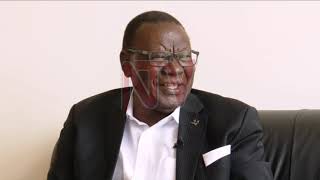
Chris Rwakasisi is one of Uganda’s most dramatic and controversial political figures a man whose life story encapsulates the turbulence, tragedy, and eventual redemption that defined Uganda’s post-independence political history.
Serving as Minister of State in charge of Security under President Milton Obote’s second government (1980–1985), Rwakasisi wielded immense power as the head of the feared National Security Agency (NASA).
He was subsequently arrested, sentenced to death, spent 24 years on death row at Luzira Maximum Prison, and was ultimately pardoned by President Yoweri Museveni in 2009 the same man he had once considered his greatest adversary.
He has since transformed into a preacher of reconciliation and forgiveness.
Profile Details
| Full Name | Chris Rwakasisi |
| Birthplace | Ankole Region, Western Uganda |
| Nationality | Ugandan |
| Occupation | Former Politician, Former Security Minister, Preacher, Reconciliation Advocate |
| Political Party | Uganda People’s Congress (UPC) |
Early Life
Chris Rwakasisi was born and raised in the Ankole region of western Uganda. He grew up in a period of great political change in East Africa, as the continent was transitioning from colonial rule to independence. From his youth, Rwakasisi was politically active, becoming the head of the Uganda People’s Congress (UPC) youth league in Ankole a role that brought him to the attention of future prime minister and president Milton Obote.
Rwakasisi’s first encounter with Obote came before Uganda’s independence in 1962, when Obote visited Mbarara District to address political rallies ahead of independence elections. As head of the UPC youth league in Ankole, Rwakasisi was strategically positioned to become one of Obote’s earliest political allies. Their relationship would prove to be the defining force of Rwakasisi’s political career.
Education
Chris Rwakasisi received formal education and went on to work in political and legal affairs for the Ugandan government. He was later trained in Russia as an intelligence information gatherer a specialisation that would prove central to his later role as head of the National Security Agency (NASA) under the Obote II government. His Russian-trained intelligence background made him uniquely suited for the security architecture of Obote’s second administration.
Career
Rwakasisi’s public career began in earnest in 1969 when he joined Uganda’s President’s Office, heading the legal and political affairs desk. It was in this capacity that he met a young Yoweri Museveni in 1970, who had joined as a research assistant reporting directly to him an irony that would become one of the most striking footnotes of Ugandan political history.
When Idi Amin overthrew Obote in January 1971, Rwakasisi was arrested and imprisoned at Makindye Military Police Barracks for six months. He was released and remained politically connected to the UPC and Obote throughout the years of Amin’s brutal dictatorship. When the Uganda National Liberation Front (UNLF) ousted Amin in 1979, Rwakasisi returned to political prominence, serving as an equivalent of Minister of Commerce under President Yusuf Lule’s transitional government, and later as National Political Advisor under President Godfrey Binaisa.
When Obote was restored to power following the 1980 elections, Rwakasisi rose to his highest position yet State Minister in the Office of the President, effectively heading the National Security Agency (NASA), described by observers as a feared secret police force. In this role, he wielded power so vast that he was effectively described as “the Ministry of Security” himself. His mandate was to suppress Obote’s opponents, including the National Resistance Army (NRA) led by Museveni, who was waging a bush war from the Luwero Triangle.
The Luwero Triangle became one of the bloodiest chapters in Ugandan history, with tens of thousands of civilians killed. Rwakasisi’s NASA was accused of orchestrating mass killings, abductions, and torture of suspected rebel collaborators. The operations included the feared “panda gaari” (Kiswahili for “board the vehicle”) sweeps, where citizens were forcibly loaded onto vehicles and taken to illegal detention centres. Rwakasisi consistently maintained his innocence, insisting he was following orders in an extraordinarily chaotic security environment.
The turning point in his fortunes came on July 27, 1985, when Obote’s government was overthrown in a military coup led by General Tito Okello Lutwa. Rwakasisi was one of the first to be arrested, apprehended while attempting to flee across the River Nile at Jinja. He was initially detained at Magamaga Barracks before being transferred to Luzira Maximum Prison. When Museveni’s NRA overthrew Okello in January 1986 and took power, Rwakasisi remained imprisoned. He was formally tried and on June 30, 1988, convicted on six counts of kidnapping with intent to harm and sentenced to death.
What followed was an extraordinary 24 years on death row at Luzira Prison, during which Rwakasisi underwent a profound personal transformation. He found deep Christian faith, became an avid reader, and began to preach reconciliation and forgiveness from within prison walls. He survived multiple near-executions and steadfastly maintained his innocence throughout.
In January 2009, President Yoweri Museveni signed an “Instrument of Release” and granted Rwakasisi a presidential pardon, freeing him after more than two decades of incarceration. The irony was not lost on observers the man Rwakasisi had once hunted as a rebel enemy was the one who ultimately set him free. Since his release, Rwakasisi has embraced his role as a preacher and advocate for national reconciliation, travelling in Uganda and abroad to preach forgiveness and healing. He has since described Museveni as his “best friend” a remarkable statement that speaks to the transformation both men have undergone.
He later received a position as Senior Presidential Adviser, further signalling his reintegration into Ugandan political life.
Personal Life
After his release from prison in 2009, Chris Rwakasisi rebuilt his life around faith and public service. He regularly preaches at church conventions, including at the Bweranyangi mini-convention of the West Ankole Diocese, where he has delivered sermons on reconciliation. Despite not having studied Theology formally, he has taken on the burden of preaching alongside ordained pastors and clergy.
His personal testimony from accused perpetrator of state violence to death row inmate to pardoned preacher has become one of Uganda’s most remarkable stories of human transformation and the possibility of reconciliation even in the most divided societies.
Net Worth
Specific financial information about Chris Rwakasisi’s net worth is not publicly available. Having spent over two decades in prison, he did not accumulate wealth during his most productive years. Since his release, he has focused on ministry, public speaking, and advisory roles.
FAQs
Who is Chris Rwakasisi?
Chris Rwakasisi is a former Ugandan Security Minister under President Milton Obote II who spent 24 years on death row at Luzira Prison before being pardoned by President Museveni in 2009.
What was NASA under Obote?
NASA (National Security Agency) was a feared intelligence and security agency under the Obote II government that was accused of mass killings, abductions, and torture of perceived opponents.
Why was Rwakasisi imprisoned?
He was convicted in 1988 on six counts of kidnapping and sentenced to death following the NRA takeover. He served over 24 years on death row before receiving a presidential pardon.
How did Rwakasisi know Museveni?
Museveni worked under Rwakasisi as a research assistant in Uganda’s President’s Office in 1970, making their later political rivalry and eventual reconciliation one of the most remarkable in East African history.
Conclusion
Chris Rwakasisi’s biography is among the most extraordinary in the annals of Ugandan history. From the heights of unchecked state power to the depths of death row, and finally to a life dedicated to preaching forgiveness, his journey reflects the full spectrum of human experience power, suffering, faith, and redemption. He stands today as a living symbol of Uganda’s capacity for reconciliation, a reminder that even the most divided societies can find paths to healing.