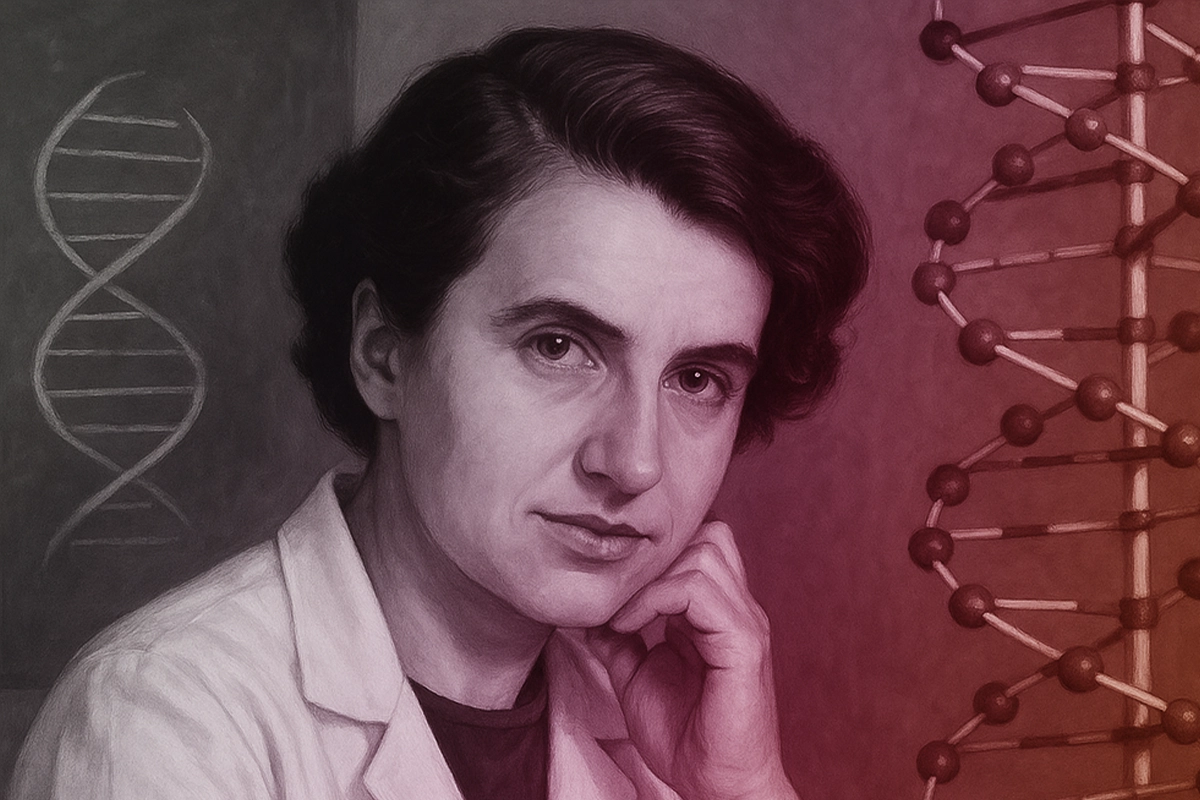
Rosalind Franklin was a pioneering British chemist and X-ray crystallographer whose groundbreaking research played a pivotal role in one of the most significant scientific discoveries of the 20th century, the double helix structure of DNA.
Despite being one of the most brilliant scientific minds of her generation, her contributions were largely overlooked during her lifetime, and she died without receiving the recognition she deserved.
Today, she is celebrated worldwide as a feminist icon, a forgotten heroine of science, and one of the greatest scientists in history.
Profile
| Full Name | Rosalind Elsie Franklin |
| Born | July 25, 1920 |
| Died | April 16, 1958 (aged 37) |
| Birthplace | Notting Hill, London, England |
| Nationality | British |
| Occupation | Chemist, X-ray Crystallographer, Scientist |
| Religion | Jewish |
| Parents | Ellis Franklin (father), Muriel Frances Waley (mother) |
Early Life
Rosalind Elsie Franklin was born on July 25, 1920, in Notting Hill, London, England, into a well-connected and prominent Jewish family. Her great-uncle, Herbert Samuel, was a historic figure who served as the first practicing Jewish member of the British cabinet, serving as Home Secretary in 1916. The Franklin family was deeply invested in education, public service, and intellectual achievement.
From a very young age, Rosalind displayed exceptional academic talent, particularly in mathematics and science. She was a precocious child with a keen, analytical mind, and her passion for science was evident before she reached her teenage years. At a time when women pursuing science faced both visible and invisible barriers, her father was initially uncertain about sending her down such a difficult path. However, recognizing her extraordinary capabilities, he enrolled her in St. Paul’s Girls’ School in London, one of the very few schools in England that taught science to girls. She passed her final examinations with distinction.
Education
In 1938, Rosalind Franklin entered Newnham College at the University of Cambridge, where she studied chemistry as part of the Natural Sciences Tripos. She graduated in 1941 and was awarded a research scholarship. She pursued her doctorate under the supervision of Ronald Norrish at Cambridge, and in 1945, she submitted a thesis titled The Physical Chemistry of Solid Organic Colloids with Special Reference to Coal, earning her PhD in physical chemistry at the age of just 25.
After her doctorate, she worked at the British Coal Utilisation Research Association (BCURA), where she conducted important research into the properties and microstructure of coal and other carbon materials. This work led to 19 published papers on coals and carbons that were highly regarded in the scientific community. She later conducted research in Paris at the Laboratoire Central des Services Chimiques de l’État, where she honed her X-ray diffraction skills under expert guidance.
Career
In 1950, Rosalind Franklin received a three-year research fellowship at King’s College London, where she was tasked with applying X-ray crystallography techniques to the study of DNA, then one of the most hotly contested scientific puzzles in the world. Working with research student Raymond Gosling, she produced two sets of extraordinarily high-resolution X-ray diffraction images of crystallized DNA fibers. One of these images, known as Photograph 51, was one of the clearest images of DNA’s structure ever captured and provided critical evidence that DNA had a helical structure.
The tragedy of Franklin’s story lies in what happened next. Without her knowledge or explicit consent, her colleague Maurice Wilkins showed Photograph 51 to James Watson and Francis Crick, who were working to build a theoretical model of DNA. The data contained in the image, specifically the precise measurements and structural details it revealed, provided Watson and Crick with the crucial clues they needed to construct their iconic double helix model, which they published in 1953.
Franklin left King’s College in 1953 and moved to Birkbeck College, London, where she spent the final years of her career studying the tobacco mosaic virus (TMV) and the polio virus. In 1955, she published seminal work on the TMV in the prestigious journal Nature, and she went on to apply for grants to further investigate the poliovirus. She published a total of 21 papers on viruses during this period, a remarkable output for a researcher at her career stage.
In 1962, four years after her death, James Watson, Francis Crick, and Maurice Wilkins were awarded the Nobel Prize in Physiology or Medicine for the discovery of the structure of DNA. Nobel Prizes are not awarded posthumously, and Franklin’s essential contributions went officially unrecognized at the highest scientific level, an injustice that has been widely discussed and condemned by the scientific community ever since. Rosalind Franklin published consistently throughout her career, including 19 papers on coals and carbons, five on DNA, and 21 on viruses.
Awards & Legacy
- Her work was foundational to the 1962 Nobel Prize in Physiology or Medicine (awarded posthumously to Watson, Crick, and Wilkins)
- The European Space Agency named their ExoMars rover the Rosalind Franklin in her honor
- Rosalind Franklin University of Medicine and Science, Illinois, USA, was dedicated to her in 2004
- A statue of Rosalind Franklin was unveiled at the university in May 2014
- Widely recognized today as one of the greatest women in scientific history
Personal Life
Rosalind Franklin was known to be deeply passionate about her scientific work and was regarded as meticulous, determined, and fiercely independent. She never married and had no known romantic relationships that she made public. She was an avid traveler who loved exploring new cultures, particularly during her years working in Paris, which she described as some of the happiest of her life. She valued deep intellectual friendships and was known for her warmth and wit among close friends, despite a reserved exterior.
Franklin was diagnosed with ovarian cancer in 1956. Despite undergoing multiple treatments, she continued working vigorously until near the end of her life. She passed away on April 16, 1958, in Chelsea, London, at the tragically young age of 37. Her early death robbed the world of one of its most brilliant scientific minds at the height of her powers.
Net Worth
As a university researcher and scientist working in the mid-20th century, Rosalind Franklin did not accumulate personal wealth in the way modern celebrities or business figures do. Her financial resources during her lifetime were modest, consisting primarily of her research salaries and fellowships. Her true legacy lies not in financial wealth but in the incalculable scientific value of her discoveries.
FAQs
Who is Rosalind Franklin?
She was a British chemist and X-ray crystallographer whose research on DNA, particularly Photograph 51, was pivotal in the discovery of DNA’s double helix structure.
Why didn’t Rosalind Franklin win the Nobel Prize?
The Nobel Prize is not awarded posthumously. She died in 1958, four years before Watson, Crick, and Wilkins received the 1962 Nobel Prize. Her contributions were not formally credited at the time.
What is Photograph 51?
Photograph 51 is an X-ray diffraction image of DNA captured by Franklin and her student Raymond Gosling in 1952. It provided critical evidence that DNA has a helical structure.
When did Rosalind Franklin die?
She died on April 16, 1958, at the age of 37, from ovarian cancer.
Conclusion
Rosalind Franklin’s life and work represent one of the most profound examples of brilliant achievement overshadowed by gender bias and institutional injustice.
In the decades since her death, the scientific community and the broader public have increasingly recognized her indispensable contribution to one of history’s most important discoveries.
Her story continues to inspire scientists, feminists, and truth-seekers around the world, and her name, now etched on a Mars rover and a university, ensures that her legacy will endure long into the future.