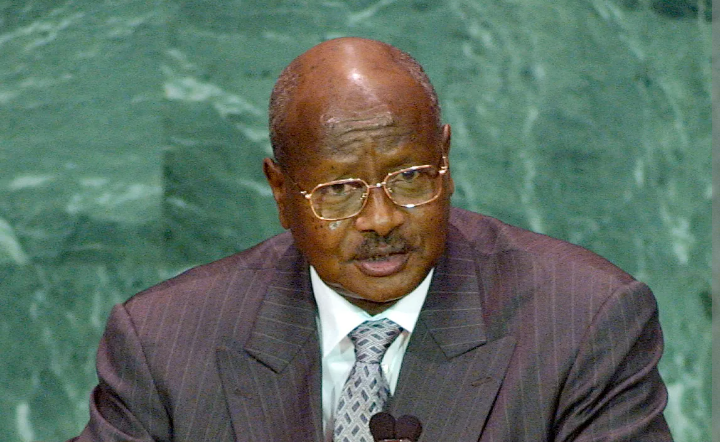
Yoweri Kaguta Museveni Tibuhaburwa is a Ugandan politician and former rebel leader who has served as President of Uganda since 1986, making him one of Africa’s longest-serving heads of state.
Rising to power through a guerrilla insurgency that toppled previous regimes, Museveni initially won praise for restoring political stability and economic growth in Uganda, though his nearly four-decade rule has increasingly drawn criticism over corruption, suppressed dissent, and his persistent refusal to relinquish power.
Profile
| Full Name | Yoweri Kaguta Museveni Tibuhaburwa |
| Born | September 15, 1944 |
| Age | 81 years old |
| Birthplace | Ntungamo District (Mbarara region), Uganda |
| Nationality | Ugandan |
| Occupation | President of Uganda, Former Rebel Leader, Politician |
| Parents | Cattle farmers (Ankole pastoralist family) |
| Spouse | Janet Kataaha Museveni (married August 1973) |
| Children | Four children, including Muhoozi Kainerugaba, Natasha Karugire, Patience Rwabwogo, and Diana Kamuntu |
| Net Worth | Not officially disclosed; estimated in the tens of millions of dollars by various unofficial sources |
Early Life
Yoweri Kaguta Museveni was born on September 15, 1944, in the Mbarara district (now part of Ntungamo District) in southwestern Uganda, into a family of cattle farmers belonging to the Ankole pastoralist community. Growing up in a rural farming household, Museveni attended missionary schools, where he received his early education. His exposure to political ideas grew substantially during his university years, when he traveled to Tanzania to study political science and economics at the University of Dar es Salaam, completing his Bachelor of Arts degree in 1970. While at university, Museveni became chairman of a leftist student organization aligned with various African liberation movements, immersing himself in the revolutionary and pan-Africanist ideologies that would later define his political career. He also took time away from his studies to learn guerrilla military tactics in Mozambique with Samora Machel’s Front for the Liberation of Mozambique (FRELIMO), experience that proved instrumental in shaping his later military strategies. He returned to write a university thesis examining philosopher Frantz Fanon’s theories of revolution as applied to the African context.
Education
Museveni’s formal education began at missionary schools in Uganda before he proceeded to higher education at the University of Dar es Salaam in Tanzania, where he earned a Bachelor of Arts degree in Political Science and Economics in 1970. His time at this prominent East African university, known during that era as a hub for pan-African and revolutionary political thought, profoundly shaped his ideological development and laid the groundwork for his future role as both a guerrilla leader and head of state.
Career
After completing his university studies, Yoweri Museveni briefly served in the intelligence service under Ugandan President Milton Obote. When Idi Amin seized power in a 1971 coup, Museveni fled into exile in Tanzania, where he became involved in planning an unsuccessful coup attempt against Amin in 1972. He subsequently taught for a period at a cooperative college in Moshi, Tanzania, while continuing to organize opposition to Amin’s dictatorship. In 1973, he formed the Front for National Salvation (FRONASA), a militant group dedicated to overthrowing the Amin regime. That same year, in August 1973, he married Janet Kataaha.
Museveni’s military involvement escalated significantly during the Uganda-Tanzania War, which began in 1978 after Ugandan troops invaded Tanzania. Tanzanian President Julius Nyerere organized a counter-invasion, rallying various Ugandan opposition groups, including Museveni’s FRONASA forces, who participated in the campaign that ultimately led to the capture of Mbarara in 1979 and the downfall of Idi Amin’s regime. Following a disputed 1980 election that returned Milton Obote to power, Museveni and his supporters formed the Popular Resistance Army (PRA), which later merged with another rebel faction to create the National Resistance Army (NRA), the guerrilla force that would eventually carry Museveni to power.
After years of guerrilla warfare against the Obote government and its successors, Museveni’s National Resistance Army seized control of Kampala in January 1986, and he was sworn in as President of Uganda on January 26, 1986. During his presidency, Museveni initially won international praise for restoring relative political stability to a country that had endured years of civil war and dictatorship, while also implementing market-oriented capitalist economic reforms and leading notably effective early efforts to combat the HIV/AIDS epidemic in Uganda. However, his administration has also faced sustained criticism over corruption, a deteriorating environment for media freedom despite his initial support for a free press, an inability to fully eliminate the Lord’s Resistance Army insurgency in northern Uganda, and a growing intolerance of political dissent.
Museveni has been repeatedly re-elected as Uganda’s president, including being declared the winner of the January 2021 election for what was his sixth term in office, sworn in on May 12, 2021. In a controversial move in March 2024, he appointed his son, Muhoozi Kainerugaba, as head of Uganda’s military, a decision widely interpreted as part of efforts to position his son as a potential successor. In May 2023, Museveni signed into law one of the world’s strictest anti-LGBTQ bills, intensifying Uganda’s broader crackdown on LGBTQ rights and drawing significant international condemnation. He announced his intention to seek re-election once again in June 2025. Ahead of the January 2026 election, Museveni marked nearly 40 years in power, having been formally nominated as a presidential candidate by the Electoral Commission in September 2025. On January 15, 2026, Ugandans went to the polls in an election that saw Museveni face opposition leader Robert Kyagulanyi Ssentamu, known as Bobi Wine, of the National Unity Platform (NUP), among several other candidates. According to Uganda’s Electoral Commission, Museveni secured 7,946,772 votes, representing 71.65 percent of the total valid votes cast, extending his rule to a seventh term, while Bobi Wine finished second with 24.72 percent of the vote. The opposition alleged “massive” ballot stuffing during the election, and Human Rights Watch reported intensified attacks on opposition figures and supporters following the results, including mass arrests. Museveni was sworn in for his seventh presidential term on May 12, 2026, in Kampala.
Social Media
Yoweri Museveni maintains an active presence on social media platforms, particularly X (formerly Twitter), where he has used the platform to make significant political announcements, including confirming his intention to seek re-election in Uganda’s 2026 presidential race, and to communicate directly with both domestic and international audiences on matters of governance and policy.
Personal Life
Yoweri Museveni married Janet Kataaha (now Janet Kataaha Museveni) in August 1973, and the couple has four children together: Muhoozi Kainerugaba, who serves as head of Uganda’s military; Natasha Karugire, a fashion designer, filmmaker, author, and podcaster; Patience Rwabwogo; and Diana Kamuntu. During the turbulent years of conflict in Uganda, Janet Museveni and the family endured significant periods of exile, relocating first to Tanzania, then to Nairobi, Kenya, in February 1981, and later to Gothenburg, Sweden, in 1983, before returning to Uganda following the NRA’s seizure of power in 1986. Janet Museveni has since become a prominent public figure in her own right, serving as Uganda’s Minister of Education and Sports since 2016 and founding the Uganda Women’s Effort to Save Orphans (UWESO), an organization supporting war-affected and HIV/AIDS-affected orphans across the country. In 1997, Museveni published his autobiography, Sowing the Mustard Seed, which chronicles his life from his early involvement in guerrilla warfare through his rise to the presidency; copies of the book were distributed to public schools across Uganda to educate students about the country’s national history. Museveni has faced ongoing accusations of grooming his son, Muhoozi Kainerugaba, as his eventual successor, a perception reinforced by Muhoozi’s 2024 appointment as head of the Ugandan military.
Net Worth
No official, independently verified figure for Yoweri Museveni’s personal net worth has been publicly disclosed. As a long-serving head of state, his official income derives from his presidential salary and associated benefits, though various unofficial estimates and reports have suggested wealth in the tens of millions of dollars, factoring in extensive landholdings, business interests linked to his family, and decades of political influence within Uganda’s economy. These figures remain unconfirmed and should be treated with appropriate caution.
Frequently Asked Questions (FAQs)
Who is Yoweri Museveni?
Yoweri Kaguta Museveni is a Ugandan politician and former guerrilla leader who has served as President of Uganda since January 1986.
How did Yoweri Museveni become president?
He led the National Resistance Army (NRA) guerrilla movement that seized control of Kampala in January 1986, after years of conflict against previous Ugandan governments.
How many terms has Yoweri Museveni served as president?
He was sworn in for his seventh presidential term on May 12, 2026, following his re-election in the January 2026 vote.
Who is Yoweri Museveni’s wife?
He is married to Janet Kataaha Museveni, whom he wed in August 1973; she currently serves as Uganda’s Minister of Education and Sports.
Who are Yoweri Museveni’s children?
He has four children: Muhoozi Kainerugaba, Natasha Karugire, Patience Rwabwogo, and Diana Kamuntu.
Conclusion
Yoweri Museveni’s nearly four-decade rule over Uganda represents one of the most consequential and contested political legacies in modern African history. From his early days as a student revolutionary and guerrilla fighter to becoming one of the continent’s longest-serving heads of state, Museveni’s presidency has been marked by both genuine achievements in stability and economic development, and persistent criticism over governance, human rights, and his unwillingness to step aside from power. With his seventh term now underway following the disputed January 2026 election, and continued questions surrounding his son’s potential succession, Yoweri Museveni’s place in Uganda’s history remains as significant as it is divisive.