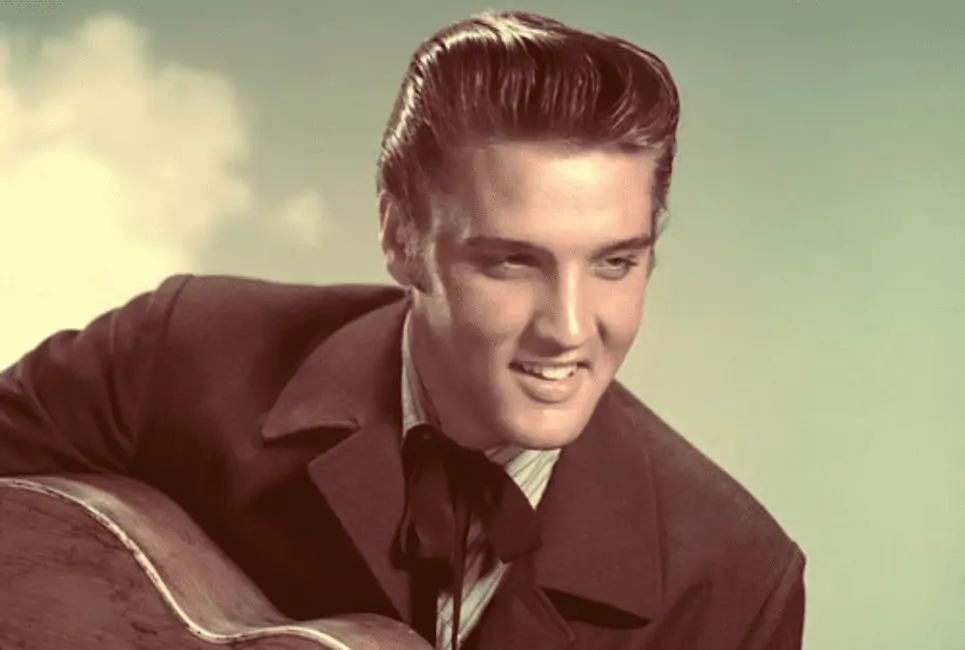
Elvis Aaron Presley, “The King of Rock and Roll”, remains one of the most culturally significant and commercially successful entertainers in the history of recorded music.
From the cotton fields of Mississippi to the stages of Las Vegas, his journey was one of extraordinary talent, revolutionary artistic vision, and ultimately, profound personal tragedy.
He transformed American music, ignited a generation, and changed the world’s popular culture forever.
Profile
| Full Name | Elvis Aaron Presley |
| Born | January 8, 1935 |
| Birthplace | Tupelo, Mississippi, USA |
| Nationality | American |
| Occupation | Singer, Actor, Entertainer |
| Spouse | Priscilla Beaulieu (married 1967, divorced 1973) |
| Children | Lisa Marie Presley (born February 1, 1968; died January 12, 2023) |
| Parents | Vernon Presley (father), Gladys Presley (mother, died August 14, 1958) |
| Date of Death | August 16, 1977 (aged 42) |
| Place of Death | Graceland, Memphis, Tennessee |
| Cause of Death | Heart failure, contributed to by prescription drug abuse |
| Net Worth (estate) | Estimated $500 million+ (estate, as of 2026) |
Early Life
Elvis Aaron Presley was born on January 8, 1935, in a two-room shotgun house in Tupelo, Mississippi, to Vernon and Gladys Presley. He was supposed to be a twin, but his brother Jesse Garon Presley was stillborn, leaving Elvis the sole focus of his mother’s fierce and devoted love. The family was desperately poor, Vernon worked as a farmer, factory worker, and carpenter, never finding stable income. In 1948, when Elvis was thirteen, the family relocated to Memphis, Tennessee, seeking better opportunities. Growing up in Memphis exposed Elvis to a rich cross-cultural musical world: gospel music at the First Assembly of God Church, blues from Beale Street, and country music from the radio. These three strands would fuse in him to create something entirely new.
Education
Elvis attended L.C. Humes High School in Memphis, graduating in June 1953. He was a quiet, unassuming student, remembered by classmates as reserved and somewhat of an outsider. Music, however, was always his compass. His teachers and peers who heard him perform were struck by a natural, untutored gift that no formal instruction had produced.
Career
Elvis Presley’s career began in the summer of 1954 when he walked into Sun Records in Memphis, the studio run by visionary producer Sam Phillips, who had famously said he was looking for a white artist who could capture the feeling of Black music. On July 5, 1954, during a recording session, Elvis spontaneously broke into a version of Arthur Crudup’s blues song “That’s All Right” — and in that moment, rock and roll was born. His early Sun Records sides, backed by guitarist Scotty Moore and bassist Bill Black, created a sound that was simultaneously rooted in country, blues, and gospel and unlike anything that had come before.
By 1956, signed to RCA Victor, Elvis had become a national phenomenon. Television appearances on The Ed Sullivan Show — where CBS controversially instructed cameramen to film him only from the waist up, fearing the effect of his hip movements on American youth, confirmed his status as the most exciting performer of his generation. “Heartbreak Hotel”, “Hound Dog”, and “Love Me Tender” all became number-one hits that year. He was 21 years old and had changed the world.
His career was interrupted in 1958 when he was drafted into the U.S. Army. Serving as a regular soldier, declining special treatment, he was stationed in Germany, where he met a teenage Priscilla Beaulieu. He was discharged in 1960 with the rank of Sergeant. His return to civilian music was triumphant, but his manager Colonel Tom Parker steered him away from live performance and into Hollywood, where he made 33 films between 1956 and 1969, including Jailhouse Rock (1957), Blue Hawaii (1961), and Viva Las Vegas (1964). While commercially successful, most were artistically thin, and Elvis grew increasingly frustrated with the direction of his career.
His artistic resurrection came with the landmark 1968 NBC Television Special — known informally as the “’68 Comeback Special” — in which a leather-clad Elvis returned to live performance and reminded the world why he was called The King. It was followed by his celebrated residency at the International Hotel in Las Vegas beginning in 1969, which re-established him as the most exciting live performer in the world. Through the early 1970s, he toured relentlessly, performing over 500 live shows, but the gruelling schedule, combined with his increasing dependence on prescription medications, visibly eroded his health.
Personal Life
Elvis married Priscilla Beaulieu on May 1, 1967, in Las Vegas. Their daughter Lisa Marie was born exactly nine months later on February 1, 1968. The marriage was strained from the beginning by his infidelities and the pressures of his career, and Priscilla filed for divorce in 1972; it was finalised in October 1973. After the divorce, Elvis had several relationships but never remarried. He grew increasingly isolated at Graceland, surrounded by a circle of hangers-on known as the Memphis Mafia, living nocturnally, eating unhealthily, and consuming enormous quantities of prescription drugs, sedatives, stimulants, painkillers, prescribed by his personal physician, Dr George Nichopoulos.
Death
On August 16, 1977, Elvis Presley was found unresponsive on the bathroom floor of his Graceland bedroom by his fiancée, Ginger Alden. He was rushed to Baptist Memorial Hospital, where he was pronounced dead at 3:30 PM. He was 42 years old. The official cause of death was cardiac arrhythmia, though the medical examiner later identified the involvement of multiple prescription drugs as a contributing factor. Fourteen different drugs were found in his system. The world was stunned. Tens of thousands of fans descended on Memphis. His funeral procession drew crowds lining the streets for miles.
Awards and Legacy
- Inducted into the Rock and Roll Hall of Fame (1986)
- Inducted into the Country Music Hall of Fame (1998)
- Inducted into the Gospel Music Hall of Fame (2001), the first artist inducted into three different halls of fame
- 18 number-one singles on the Billboard Hot 100
- Over 600 million records sold worldwide at the time of his death; total estimated at over 1 billion since
- Grammy Lifetime Achievement Award (1971)
- Three Grammy Awards — all for gospel recordings
Net Worth
At the time of his death, Elvis had earned an estimated $4.3 billion during his lifetime, yet his estate was nearly bankrupt due to Colonel Tom Parker’s mismanagement and Elvis’s own extravagance. Priscilla Presley rescued the estate by opening Graceland to the public in 1982 and building Elvis Presley Enterprises into a multimillion-dollar corporation. Today, Graceland is the second-most-visited private home in America after the White House, and the Elvis estate generates hundreds of millions of dollars annually.
Discography
| Year | Album |
| 1956 | Elvis Presley |
| 1956 | Elvis |
| 1957 | Loving You (soundtrack) |
| 1957 | Elvis’ Christmas Album |
| 1958 | King Creole (soundtrack) |
| 1960 | Elvis Is Back! |
| 1960 | G.I. Blues (soundtrack) |
| 1961 | Blue Hawaii (soundtrack) |
| 1967 | How Great Thou Art |
| 1969 | From Elvis in Memphis |
| 1972 | Elvis as Recorded at Madison Square Garden |
| 1973 | Aloha from Hawaii via Satellite |
Filmography
| Year | Film |
| 1956 | Love Me Tender |
| 1957 | Loving You |
| 1957 | Jailhouse Rock |
| 1958 | King Creole |
| 1960 | G.I. Blues |
| 1961 | Blue Hawaii |
| 1964 | Viva Las Vegas |
| 1968 | ’68 Comeback Special (TV) |
| 1970 | Elvis: That’s the Way It Is |
| 1973 | Elvis: Aloha from Hawaii (TV) |
Conclusion
Elvis Presley’s life was a parable of both the heights and the costs of American fame. In his recordings, his films, his live performances, and the mythology that has grown around him in the nearly five decades since his death, he endures as one of the few artists of any era who genuinely changed the world. The King is, and will remain, irreplaceable.