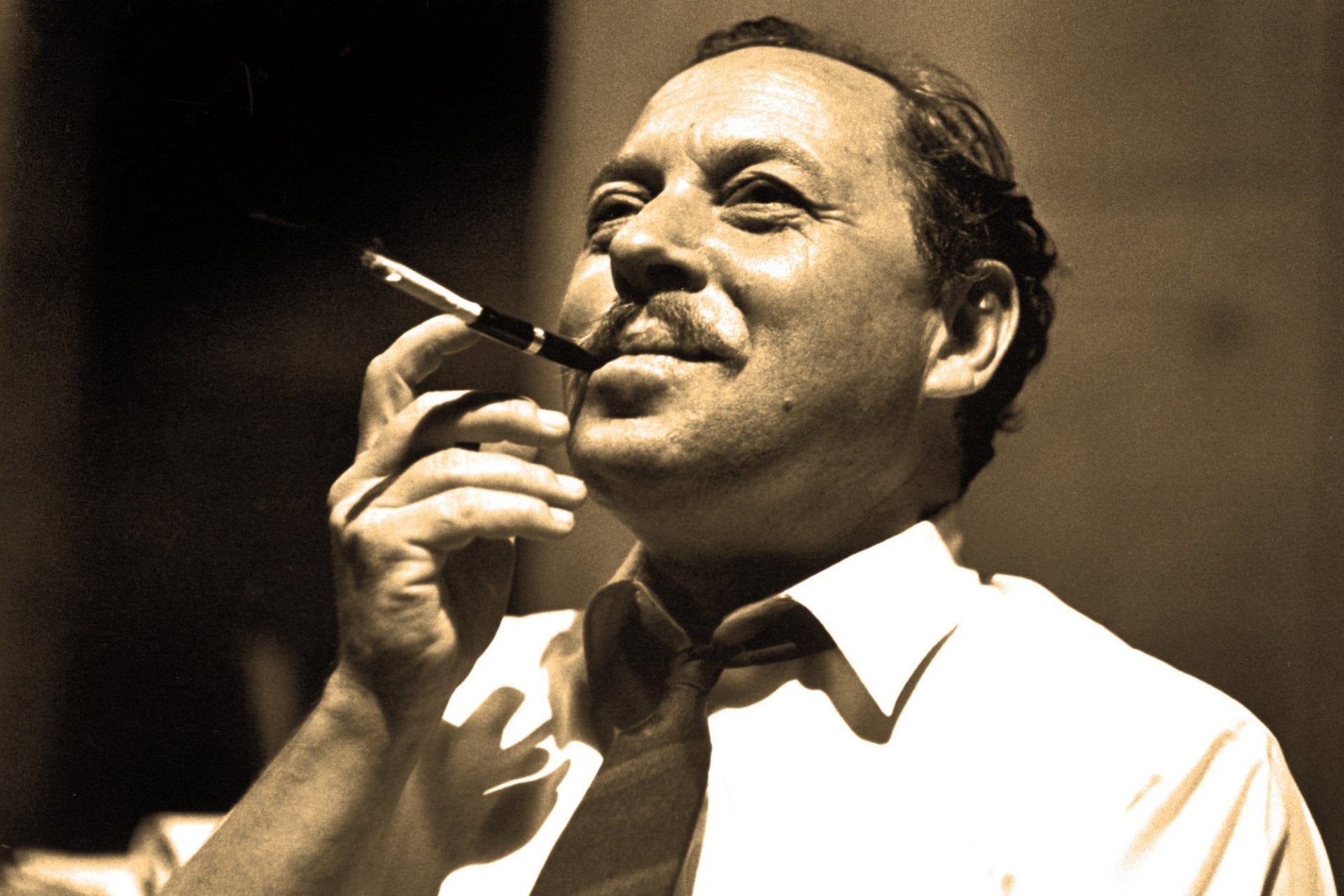
Tennessee Williams is widely regarded as one of the two or three greatest playwrights in American theatrical history.
Born Thomas Lanier Williams in 1911 in Columbus, Mississippi, he produced a body of dramatic work — including The Glass Menagerie, A Streetcar Named Desire, and Cat on a Hot Tin Roof — that redefined what American theatre could do and say.
His plays are populated with characters on the margins of sanity, dignity, and social acceptance: women who cling to fantasies because reality has been too brutal; men who cannot reconcile their desires with the world’s demands; families held together and torn apart by love and cruelty in equal measure.
He won two Pulitzer Prizes for Drama and four New York Drama Critics’ Circle Awards. He also lived a life as dramatic and self-destructive as anything he put on the stage.
Profile
| Full Name | Thomas Lanier Williams III |
| Stage Name | Tennessee Williams |
| Date of Birth | 26 March 1911 |
| Date of Death | 25 February 1983 (aged 71) |
| Birthplace | Columbus, Mississippi, United States |
| Nationality | American |
| Occupation | Playwright, Screenwriter, Poet, Fiction Writer |
| Parents | Cornelius Coffin Williams (father); Edwina Dakin Williams (mother) |
| Siblings | Rose Isabel Williams (sister); Walter Dakin Williams (brother) |
| Partner | Frank Merlo (1948–1963, until Merlo’s death) |
| Place of Death | Hotel Elysee, New York City, United States |
Early Life
Thomas Lanier Williams III was born on 26 March 1911 in Columbus, Mississippi, the second of three children born to Cornelius Coffin Williams and Edwina Dakin Williams. His father, known as C.C. Williams, was a travelling shoe salesman who was frequently absent and, when present, volatile, critical, and physically intimidating — a demanding, hard-drinking man who had little patience for his sensitive, bookish son. His mother, Edwina, was a genteel Southern woman of religious convictions, dramatic temperament, and social pretensions, deeply attached to the culture and manners of the Old South. The tension between these two parental archetypes — the brutish masculine world and the fragile feminine world of refined illusions — would echo through virtually every play Williams ever wrote.
Williams described his earliest years in Mississippi as genuinely happy. Everything changed when the family relocated to St. Louis, Missouri, in 1918, when he was seven years old. The move from the gracious, unhurried pace of small-town Mississippi to the urban industrial city of St. Louis was a shock from which Williams and his sister Rose never entirely recovered. He felt displaced, socially inadequate, and increasingly close to his sister Rose — a relationship of profound tenderness and mutual dependence that would shape the rest of his life and recur throughout his art.
As a teenager in St. Louis, Williams was already writing. He published his first short story, “A Summer of Smoke,” in a popular magazine when he was sixteen. He was an introverted, often bullied young man, uncomfortable in the masculine social world his father represented and drawn inward to writing, reading, and the companionship of his sister and mother. The gap between himself and his father was unbridgeable, and Cornelius Williams reportedly showed nothing but contempt for his son’s literary ambitions.
Education
Williams attended the Eugene Field School, Soldan High School, and University City High School in St. Louis. He enrolled at the University of Missouri in Columbia in 1929 to study journalism, but his father withdrew him from university in 1932 during the economic hardships of the Great Depression and forced him to work as a clerk at the International Shoe Company — the same firm where Cornelius worked as an executive. Williams despised the job profoundly. He worked there for three years, writing poems and stories by night after factory hours, until a nervous breakdown in 1935 forced him home to recover. After recuperating in Memphis, he resumed his education at Washington University in St. Louis, where he encountered a community of poets and began to develop his dramatic voice. He eventually enrolled at the University of Iowa, where he graduated in 1938 with a Bachelor of Arts degree. It was during his college years that he adopted the nickname “Tennessee” — a reference to his father’s Tennessee roots and his own Southern identity — abandoning the name Thomas Lanier Williams as too formal and literary.
Career
Early Struggles (1938–1944)
After graduating, Williams moved to New Orleans — a city whose sensory richness, racial complexity, bohemian tolerance, and heat-soaked atmosphere became the spiritual home of his imagination and the setting of his most celebrated work. He lived on the margins of poverty for several years, working odd jobs, writing furiously, and beginning to explore his identity as a gay man in a city that offered more latitude than Missouri ever had. His early plays attracted the attention of agents but struggled to find production. His first Broadway production, Battle of Angels (1940), closed ignominiously in Boston following disastrous audience and critical responses. Williams never forgot the humiliation, and would later revise the play into the more successful Orpheus Descending (1957).
Breakthrough: The Glass Menagerie (1944–1945)
Williams’ breakthrough came with The Glass Menagerie, which debuted in Chicago in December 1944 and opened on Broadway on 31 March 1945 to rapturous reviews. The play — a memory play narrated by Tom Wingfield, a thinly disguised version of Williams himself — depicts a fragile mother clinging to the illusions of her Southern past, a crippled daughter who retreats into a collection of glass animals, and a son desperate to escape into the world. The characters were barely disguised portraits of Williams’s own family: Amanda Wingfield was his mother, Laura was his sister Rose, and Tom was himself. The play won the New York Drama Critics’ Circle Award for 1945 and made Williams a celebrated literary figure overnight.
A Streetcar Named Desire (1947)
Two years later, A Streetcar Named Desire confirmed Williams as the defining voice of mid-century American theatre. First performed on Broadway on 3 December 1947, the play starred Marlon Brando as the elemental, violent Stanley Kowalski and Jessica Tandy as the deluded, disintegrating Blanche DuBois. The collision between these two characters — old Southern gentility destroyed by brutal modern sexuality and economic reality — gripped audiences and critics with an intensity rarely seen on the American stage. The play won the 1948 Pulitzer Prize for Drama and the New York Drama Critics’ Circle Award. It was later adapted into a landmark 1951 film by Elia Kazan, starring Brando and Vivien Leigh, which won four Academy Awards.
Peak Years (1948–1961)
The years between Streetcar and the early 1960s represent Williams’s most prolific and celebrated period. Summer and Smoke (1948) explored the repression of desire in a small Southern town. The Rose Tattoo (1951) won the Tony Award for Best Play. Camino Real (1953) was an ambitious experimental work that failed commercially but revealed Williams’s restless formal experimentation. Cat on a Hot Tin Roof (1955), the story of a wealthy Mississippi Delta family coming apart under the pressure of lies, alcoholism, homosexuality, and mortality, won Williams his second Pulitzer Prize for Drama and his third New York Drama Critics’ Circle Award. Suddenly Last Summer (1958), a one-act dealing with lobotomy, repressed homosexuality, and psychological horror, showed his darker, more experimental side. Sweet Bird of Youth (1959) and The Night of the Iguana (1961), his last major Broadway success, won his fourth New York Drama Critics’ Circle Award.
Decline and Late Career (1963–1983)
The death of his longtime partner Frank Merlo from lung cancer in 1963 sent Williams into a profound depression from which he never fully recovered. He descended into addiction — to prescription drugs and alcohol — and produced a succession of plays in the late 1960s and 1970s that were largely rejected by critics and audiences. He suffered what he described as his “Stoned Age.” In 1969, his brother Dakin committed him to a psychiatric facility in St. Louis for three months. He continued writing into the late 1970s and early 1980s, producing works including Small Craft Warnings (1972) and Vieux Carré (1977), though none recaptured the success of his peak years. His memoir, Memoirs, was published in 1975 to mixed reviews but provided a candid account of his personal and professional life.
Personal Life
Williams’s most important personal relationship was with Frank Merlo, a Sicilian-American he met in 1948 and lived with for fifteen years. Merlo grounded Williams, managed his domestic life, and provided the stability that allowed some of his greatest plays to be written. Merlo’s death in 1963 from lung cancer left a wound from which Williams never recovered.
His relationship with his sister Rose was the emotional through-line of his entire life. Rose was diagnosed with schizophrenia and, in 1943, underwent a prefrontal lobotomy at the urging of their mother — an irreversible procedure that left her institutionalised for most of the rest of her long life. Williams carried guilt about the lobotomy for the rest of his life, blamed his mother for consenting to it, and obsessively returned to themes of mental illness, psychic violation, and destroyed innocence in his work. He provided financially for Rose throughout his life and left her the bulk of his estate.
Death
Tennessee Williams died on 25 February 1983 at the Hotel Elysee in New York City. He was 71 years old. He choked to death on a bottle cap — a small plastic cap from an eyedrop or nasal spray bottle — while under the influence of barbiturates and alcohol, according to the medical examiner’s report. His death was entirely consistent with the combination of substance dependency and isolation that had characterised his final two decades.
Awards and Nominations
- 1945 — New York Drama Critics’ Circle Award — Best Play — The Glass Menagerie — Won
- 1948 — Pulitzer Prize for Drama — A Streetcar Named Desire — Won
- 1948 — New York Drama Critics’ Circle Award — Best Play — A Streetcar Named Desire — Won
- 1951 — Tony Award — Best Play — The Rose Tattoo — Won
- 1955 — Pulitzer Prize for Drama — Cat on a Hot Tin Roof — Won
- 1955 — New York Drama Critics’ Circle Award — Best Play — Cat on a Hot Tin Roof — Won
- 1962 — New York Drama Critics’ Circle Award — Best Play — The Night of the Iguana — Won
- 1969 — National Institute of Arts and Letters Gold Medal for Drama — Won
- 1980 — Presidential Medal of Freedom — Won
Major Works
- Battle of Angels (1940) — Play
- The Glass Menagerie (1944) — Play; New York Drama Critics’ Circle Award
- A Streetcar Named Desire (1947) — Play; Pulitzer Prize, Tony Award
- Summer and Smoke (1948) — Play
- The Rose Tattoo (1951) — Play; Tony Award for Best Play
- Camino Real (1953) — Play
- Cat on a Hot Tin Roof (1955) — Play; Pulitzer Prize
- Orpheus Descending (1957) — Play (revised from Battle of Angels)
- Suddenly Last Summer (1958) — One-act play
- Sweet Bird of Youth (1959) — Play
- The Night of the Iguana (1961) — Play; New York Drama Critics’ Circle Award
- Small Craft Warnings (1972) — Play
- Memoirs (1975) — Autobiography
- Vieux Carré (1977) — Play
- A Lovely Sunday for Creve Coeur (1979) — Play
- Clothes for a Summer Hotel (1980) — Play
Conclusion
Tennessee Williams gave the American theatre its most anguished and compassionate voice. His plays endure because the people in them — Blanche DuBois, Amanda Wingfield, Brick and Maggie, the Reverend Shannon — are not types or symbols but fully inhabited human beings, rendered with a lyrical precision and a hard-won psychological honesty that no passage of time diminishes. His own life — lived in the grip of desire, guilt, addiction, and grief — was inseparable from his art. He was both the survivor who told the story and the character being destroyed by it. That paradox is what makes Tennessee Williams not just a great playwright, but an irreplaceable witness to the human condition.