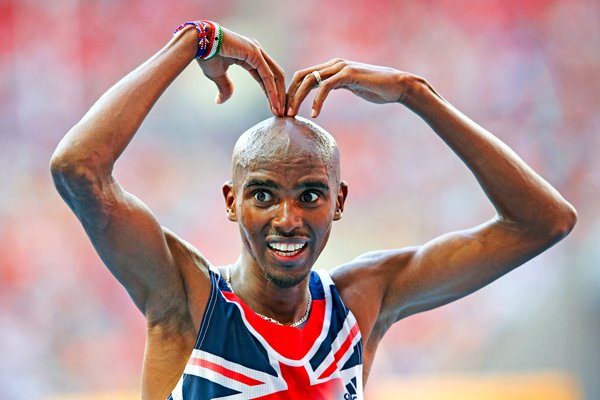
Sir Mo Farah is widely regarded as Great Britain’s greatest track and field athlete in modern Olympic history.
With four Olympic gold medals and six World Championship titles to his name, Farah’s journey from a war-torn childhood in Somalia to global athletic stardom is one of the most inspiring stories in sports.
This Mo Farah biography explores his early life, education, career achievements, personal life, and net worth.
Profile
| Full Name | Sir Mohamed Muktar Jama Farah |
| Stage Name | Mo Farah |
| Born | March 23, 1983 |
| Age | 43 years old |
| Birthplace | Somalia (some accounts cite Gabiley, in present-day Somaliland) |
| Nationality | British (Somali-born) |
| Occupation | Retired Long-Distance Runner |
| Height | 1.75 m (5 ft 9 in) |
| Religion | Islam |
| Parents | Muktar Farah (father), Amran Farah (mother) |
| Spouse | Tania Nell (married 2010) |
| Children | Four: twin daughters Aisha and Amani, son Hussein, and stepdaughter Rhianna |
| Net Worth | Estimated between $4 million and £3.8 million |
Early Life
Mo Farah was born on March 23, 1983, in Somalia, during a period of significant unrest in the region. As civil conflict intensified, his family relocated to Djibouti, where Farah spent part of his early childhood alongside his twin brother. The turmoil of war deeply affected his family, and accounts indicate his father passed away due to the conflict when Farah was young, while he was also separated from his mother for a period during this difficult time.
At the age of eight, Farah moved to England to join his father, who was working at Heathrow Airport. Arriving with very little knowledge of English, Farah faced considerable challenges adapting to a new language, culture, and academic environment. He completed his education at Feltham Community College in London, where he initially struggled academically due to the language barrier, until a physical education teacher, Alan Watkinson, recognized his exceptional talent in athletics and football, and began nurturing his potential as a runner.
Education
Mo Farah attended Feltham Community College in London for his secondary education, where his athletic talent was first discovered and cultivated by his teacher Alan Watkinson. He later attended St Mary’s University in Twickenham, where he trained and competed for Newham and Essex Beagles, laying the foundation for his professional athletic career.
Career
Mo Farah’s competitive running career began in 1996 when he joined the London Borough of Hounslow Athletics Club, quickly gaining recognition for his talent in cross-country events. He won his first major national title, the English Schools Cross Country Championship, at just 15 years old, and went on to claim his first international title at the European Athletics Junior Championships in 2001, winning the 5,000m race.
Farah’s career reached new heights at the 2012 London Olympics, where he achieved a historic “double,” winning gold medals in both the 5,000m and 10,000m events. He repeated this remarkable feat four years later at the 2016 Rio Olympics, securing back-to-back doubles and cementing his status as one of the greatest distance runners of his generation. In total, Farah won four Olympic gold medals and ten global championship titles, including World Championship gold medals in the 5,000m in 2011, 2013, and 2015, and the 10,000m in 2013, 2015, and 2017.
Beyond track events, Farah transitioned into long-distance road running later in his career, competing in marathons including the London Marathon. From 2011 to 2017, he trained with the Nike Oregon Project under coach Alberto Salazar, living in Portland, Oregon, before cutting ties with Salazar and returning to London at the end of 2017. Beyond his athletic accomplishments, Farah has become a prominent advocate for human rights, particularly after publicly revealing his own experience of being trafficked to the United Kingdom as a child, a disclosure that brought global attention to issues of child trafficking and modern slavery.
Awards & Nominations
| Knighted in 2017 for services to athletics |
| Commander of the Order of the British Empire (CBE), New Year Honours 2013 |
| European Athlete of the Year, 2011 and 2012 |
| Four Olympic gold medals (2012 and 2016 Games) |
| Six World Championship gold medals |
Personal Life
Mo Farah married his long-time girlfriend Tania Nell in April 2010 in Richmond, London, in a ceremony attended by several prominent British athletes. The couple has twin daughters, Aisha and Amani, born in August 2012, and a son named Hussein, born in 2015. Farah also has a stepdaughter, Rhianna, from Tania’s previous relationship. A practicing Muslim, Farah is known for his charitable work, including launching the Mo Farah Foundation in 2011 following a trip to Somalia, and he remains a passionate supporter of Arsenal Football Club.
Net Worth
Mo Farah’s net worth is estimated to be between $4 million and £3.8 million, accumulated through his prize earnings, sponsorship deals, and endorsements with major global brands including Nike, Quorn, Virgin Media, Lucozade, and Bupa over the course of his decorated athletic career.
FAQs
Who is Mo Farah?
Mo Farah is a retired Somali-British long-distance runner, widely regarded as Great Britain’s most successful track athlete in Olympic history.
How old is Mo Farah?
He was born on March 23, 1983, making him 43 years old as of 2026.
How many Olympic gold medals does Mo Farah have?
He has won four Olympic gold medals, achieved through back-to-back doubles in the 5,000m and 10,000m at the 2012 and 2016 Olympics.
Is Mo Farah married?
Yes, he is married to Tania Nell, with whom he has four children.
Was Mo Farah a trafficking victim?
Yes, Farah publicly revealed that he was trafficked to the United Kingdom as a child, a disclosure that drew global attention to child trafficking issues.
Conclusion
Mo Farah’s life story is a powerful testament to resilience, talent, and determination.
From overcoming a traumatic childhood marked by war and trafficking to becoming one of the most decorated distance runners in Olympic history, Farah’s legacy extends far beyond his medals.
His advocacy work and openness about his past have made him not just a sporting icon, but also an inspirational figure for resilience and human rights awareness around the world.