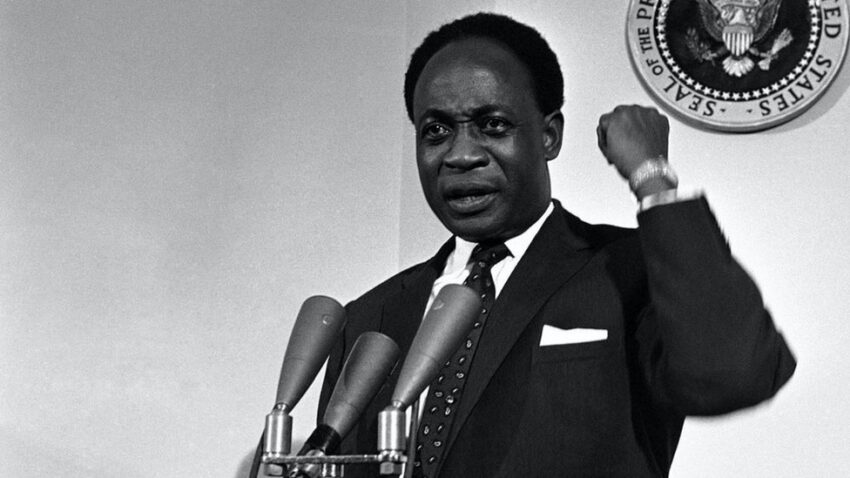
Francis Kwame Nkrumah was one of the most consequential political figures of the 20th century, a Ghanaian revolutionary, philosopher, author, and statesman whose vision, courage, and intellectual brilliance led Africa’s Gold Coast colony to become the first sub-Saharan African nation to gain independence from European colonial rule in 1957.
As Ghana’s first Prime Minister and first President, and as the founding intellectual and spiritual father of Pan-Africanism, Nkrumah’s life and legacy remain inseparable from the story of Africa’s modern self-determination.
His famous declaration, “Seek ye first the political kingdom, and all else shall be added unto you”, remains the rallying cry of African independence movements to this day.
Profile
| Full Name | Francis Nwia-Kofi Kwame Nkrumah |
| Born | September 21, 1909 |
| Died | April 27, 1972 (aged 62), Bucharest, Romania |
| Birthplace | Nkroful, Nzima, Gold Coast (now Western Region, Ghana) |
| Nationality | Ghanaian |
| Occupation | Politician, Philosopher, Author, Revolutionary |
| Religion | Catholicism (baptised); later embraced broader spiritual and African traditionalist views |
| Father | Kofi Ngonloma (goldsmith, Asona Clan) |
| Mother | Elizabeth Nyanibah (Anona Clan) |
| Spouse | Fathia Ritzk (married 1957; an Egyptian woman) |
| Children | Gamal Nkrumah, Samia Nkrumah, Sekou Nkrumah |
| Political Party | Convention People’s Party (CPP) |
Early Life
Kwame Nkrumah was born on September 21, 1909 (for official purposes, though he later calculated September 18, 1909 as the most probable date), in the village of Nkroful in the Nzima land of the Gold Coast, the British colonial territory that would one day become Ghana. He was born into the Nzima people, an Akan subgroup from the southwestern part of the country. His father, Kofi Ngonloma, was a goldsmith of the Asona Clan, and his mother, Elizabeth Nyanibah, was of the Anona Clan. As was common in Akan culture, his family and identity were traced through his mother’s matrilineal lineage.
He was baptised Roman Catholic and given the first name Francis by the priest who baptised him. He grew up in a community shaped by colonial administration, Catholic missionary education, and the enduring traditions of Akan society. From his earliest years, he displayed an exceptional intellectual hunger and was identified by his teachers as a young man of unusual promise. He demonstrated early ability as a student and became a pupil-teacher, a common path for talented young men in colonial Ghana, after eight years in elementary school.
His formative encounter with his lifelong mentor came when he attended the prestigious Achimota School (formerly Prince of Wales’ College) in Accra, where Dr. Kwegyir Aggrey, the first African member of the college’s staff and a towering intellectual figure of his generation, became his mentor. Aggrey’s philosophy of racial harmony and African self-determination profoundly shaped the young Nkrumah’s worldview and reinforced his growing conviction that African people were destined for self-governance.
Education
Kwame Nkrumah’s educational journey was one of the most ambitious and internationally diverse of any African leader of his era. After completing his training at Achimota College in 1930, he taught at Catholic elementary schools in Ghana for five years before making one of the most consequential decisions of his life, to pursue higher education in the United States.
In 1935, he sailed to America and enrolled at Lincoln University in Pennsylvania, a historically Black college that had produced several distinguished African and African-American scholars. At Lincoln, he earned a Bachelor of Arts degree in Economics and Sociology in 1939, and a Bachelor of Arts in Theology in 1942, reflecting both his intellectual breadth and his engagement with spiritual questions of African liberation. He simultaneously pursued graduate studies at the University of Pennsylvania, where he earned a Master of Science in Education in 1943 and a Master of Arts in Philosophy in 1944, completing coursework toward a PhD, though he did not complete the doctorate. He also attended the London School of Economics (LSE) as a PhD candidate in Anthropology before transferring to University College London to study philosophy under the distinguished philosopher A.J. Ayer.
During his 12 years abroad, Nkrumah was deeply influenced by Marxist and socialist thought, the writings of W.E.B. Du Bois and Marcus Garvey, and his encounters with African diaspora intellectuals in both the United States and the United Kingdom. He helped found the African Students’ Organisation in the US and became an increasingly vocal advocate for African independence. In 1945, he attended the pivotal 5th Pan-African Congress in Manchester, alongside future heads of state including Jomo Kenyatta of Kenya and Hastings Banda of Malawi, a conference that would shape the intellectual and political direction of Africa’s independence movements for decades to come.
Career
Kwame Nkrumah returned to the Gold Coast in 1947 at the invitation of the United Gold Coast Convention (UGCC), a moderate nationalist party seeking gradual self-governance. He was appointed General Secretary of the UGCC, but quickly concluded that the party’s gradualist approach was inadequate to the urgency of the moment. When he was briefly imprisoned by the British in 1948 following widespread protests and riots, and was then released, his popularity soared among ordinary Ghanaians who saw in him not a cautious bureaucrat but a fearless liberator.
In June 1949, he founded his own party, the Convention People’s Party (CPP), with the radical platform of immediate self-government, appealing directly to the masses: farmers, workers, youth, and women in a way the UGCC’s elite structure had failed to do. His strategy of “positive action”, strikes, boycotts, and mass civil disobedience, electrified the Gold Coast. In 1950, he was imprisoned again by the British for inciting illegal strikes, but this only deepened his heroic status. While still in prison, his CPP won a landslide victory in the 1951 Gold Coast legislative elections, forcing the British to release him and appoint him as Leader of Government Business, the de facto first prime ministerial role in the territory’s history.
He became Prime Minister of the Gold Coast in 1952 and, on March 6, 1957, presided over one of the defining moments in modern African history when Ghana declared independence from Britain, becoming the first sub-Saharan African colony to achieve independence. Nkrumah’s famous declaration at the independence ceremony, “At long last, the battle has ended! Ghana, your beloved country, is free forever!”, became one of the most celebrated speeches in the history of African political oratory.
In 1960, Ghana became a Republic and Nkrumah was elected its first President. He launched an ambitious programme of industrialisation, socialist development, and Pan-African unity. He nationalised the cocoa trade, built the Akosombo Dam and the Volta River Project, established the University of Ghana’s Legon campus, and created free education and healthcare systems. He was a founding member and driving force behind the Organisation of African Unity (OAU), established in 1963, which he envisioned as the foundation for a continental federation of African states, modelled on his book Africa Must Unite (1963). He was awarded the Lenin Peace Prize by the Soviet Union in 1962.
However, his governance also attracted serious criticism. He became increasingly authoritarian, passing the Preventive Detention Act (1958) which allowed indefinite detention of political opponents without trial, taking control of the judiciary, and in 1964, making himself President for Life and establishing a one-party state. His ambitious development projects, including numerous state enterprises and the Akosombo Dam, plunged Ghana into significant debt. Food shortages, corruption, and economic mismanagement fuelled widespread discontent.
On February 24, 1966, while Nkrumah was on a diplomatic mission to Hanoi, Vietnam, his government was overthrown in a military coup led by the National Liberation Council. He was never to return to Ghana. He went into exile in Guinea-Conakry, where President Sékou Touré received him as a co-president, and he spent the remaining years of his life writing and advocating for African liberation from exile. He died in Bucharest, Romania on April 27, 1972, while seeking treatment for prostate cancer. His remains were returned to Ghana and initially interred at Nkroful; they were later reinterred at the Kwame Nkrumah Memorial Park in Accra.
Key Writings
- Ghana: The Autobiography of Kwame Nkrumah (1957)
- I Speak of Freedom (1961)
- Africa Must Unite (1963)
- Consciencism (1964)
- Neo-Colonialism: The Last Stage of Imperialism (1965)
- Challenge of the Congo (1967)
- Class Struggle in Africa (1970)
Awards & Honours
- Lenin Peace Prize – Soviet Union (1962)
- Posthumously named “Africa’s Man of the Millennium” by the BBC (2000)
- Kwame Nkrumah Memorial Park established in Accra, Ghana
- Kwame Nkrumah University of Science and Technology (KNUST) in Kumasi named in his honour
- Numerous streets, institutions, and monuments across Africa named in his honour
Social Media & Legacy
Dr. Kwame Nkrumah died in 1972, long before social media existed. His legacy is preserved and celebrated through the Kwame Nkrumah Memorial Park in Accra, the Kwame Nkrumah Mausoleum, and the continuing work of political theorists, African historians, and independence movements across the continent. His daughter Samia Nkrumah has continued his political legacy in Ghanaian politics.
Personal Life
Kwame Nkrumah married Fathia Ritzk, an Egyptian woman, on December 30, 1957, shortly after Ghana’s independence. Their marriage, between an African nationalist leader and an Egyptian woman, was itself a symbolic act of Pan-African solidarity. Together they had three children: Gamal Nkrumah, Samia Nkrumah, and Sekou Nkrumah. Gamal became a prominent journalist and editor of Al Ahram Weekly in Egypt; Samia later entered Ghanaian politics, serving as Member of Parliament for Jomoro constituency. After his exile in 1966, Fathia and the children remained primarily in Egypt.
Net Worth
Questions of personal net worth are largely inapplicable to Nkrumah’s biography, as he was a public servant and revolutionary who dedicated his life to political struggle rather than personal accumulation. The state resources he directed were for national development rather than personal enrichment, though critics have noted the economic mismanagement of some state enterprises during his tenure.
Conclusion
Kwame Nkrumah’s place in history is secure and extraordinary. As the architect of Ghanaian independence and the most influential theorist of Pan-Africanism, he gave the African liberation movement its philosophical vocabulary and its strategic vision. His shortcomings as a statesman, the authoritarianism, the economic mismanagement, the one-party state, do not erase the magnitude of what he achieved: proving to a colonised world that African people could govern themselves, uniting a continent behind the idea of its own dignity, and daring to dream of a United States of Africa when such a dream was dismissed as fantasy. Half a century after his death, that dream remains unfinished, but it is no less powerful for being incomplete. Africa’s twenty-first century story is still being written in the language Kwame Nkrumah first taught it to speak.